CoreInto vs WHMCS: how the two licences are sold
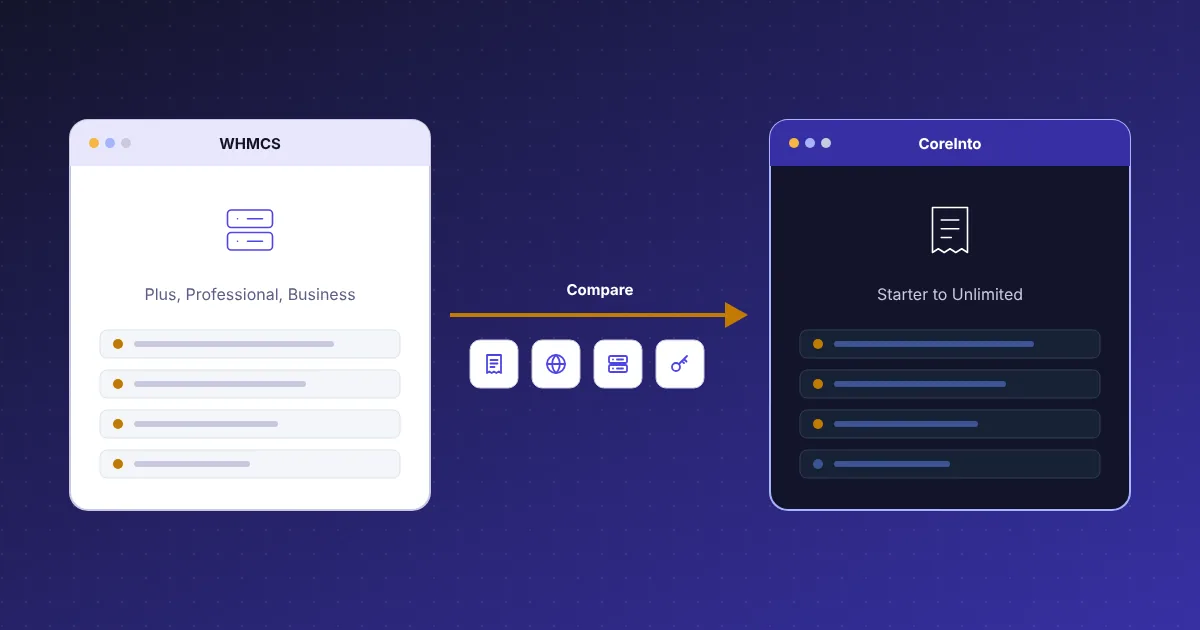
The first difference is not a feature but a pricing model. CoreInto sells six plans at system.coreinto.com that differ in exactly one respect: the number of client accounts an installation may hold. Starter holds 250, Plus 1,000, Pro 5,000, Business 25,000 and Unlimited has no limit; a 10-day Free Trial holds 25. The feature set is identical on all of them, so there is nothing to unlock later and no branded edition that puts a CoreInto badge in your client area.
WHMCS, as published in October 2026, also prices by client count, with Plus at 250 clients, Professional at 500, and Business tiers at 1,000, 2,500, 5,000, 10,000 and unlimited. The steps are closer together than CoreInto's, which means a growing company crosses them more often. What each WHMCS tier includes beyond the client limit is for the vendor's page to say, and we do not repeat it here.
A CoreInto licence is one key per installation, bound to the site's domain and folder and checked once a day. Should the licence server be unreachable, the site keeps working until the saved answer expires and then for a grace period. If the licence lapses, the admin area is restricted to the licence page, with no provisioning and no new clients added by staff, but the client area, payments and automation carry on. The key is entered in the installer, under Utilities > CoreInto Licence, or with php cli.php licence-set.
Price at 250 clients and at unlimited clients
The two ends of the scale make the difference plain. For a company with up to 250 clients, CoreInto Starter is $7.99 a month or $79.99 a year. WHMCS Plus at the same 250 clients is $34.95 a month as published in October 2026. For a company that wants no ceiling at all, CoreInto Unlimited is $19.99 a month or $199.99 a year, while WHMCS Business Unlimited is $1,999.95 a month as published in the same month.
The middle of the range follows the same pattern. CoreInto Plus holds 1,000 clients for $9.99 a month against WHMCS Business 1000 at $84.95; CoreInto Pro holds 5,000 for $12.99 against Business 5000 at $284.95; CoreInto Business holds 25,000 for $15.99, a size at which WHMCS publishes only Business 10000 at $399.95 and then Business Unlimited.
- Starter, 250 clients: $7.99 a month, $79.99 a year
- Plus, 1,000 clients: $9.99 a month, $99.99 a year
- Pro, 5,000 clients: $12.99 a month, $129.99 a year
- Business, 25,000 clients: $15.99 a month, $159.99 a year
- Unlimited: $19.99 a month, $199.99 a year
Yearly CoreInto plans work out to about two months free. Prices are in USD, the trial needs no card and is limited to one per installation, and moving to a larger plan means buying it and entering the new key; the pricing page shows the live table.
Client area templates and languages in each system
Clients judge billing software by the client area, not the admin screens. CoreInto ships two templates. Classic has a top menu with an account sidebar, and Horizon is an app shell with a dark side menu; both come in a light and a dark theme, and both start with the same pages, features and texts, so switching between them loses nothing. To make your own, copy a template folder and edit it. The store menu title and layout, the home heading, the text and the buttons are all settings.
Languages work the same way. English and Urdu are included, with right-to-left layout handled for Urdu, and any other language is added by filling in a template file that lives in storage/lang, outside CoreInto's own files, so updates do not overwrite it. When more than one language is installed and clients may choose, a language menu appears in the footer of every public and client page; the choice is kept in the browser for a year and saved on a signed-in person's account. Email templates have per-language versions, so a client who reads in Urdu receives invoices and reminders in Urdu.
WHMCS has its own templates and language packs, and its documentation is the place to check what is current; we do not state figures for it here. The customer guide shows every CoreInto client-area page in both templates, from the dashboard to licence keys.
Payment gateways and registrar modules built into each
This is a row where WHMCS is ahead on count, and it is better to say so plainly. CoreInto has five payment gateways built in: manual payment for bank transfer, mobile wallet and cash; PayPal; Stripe with cards, Apple Pay, Google Pay, saved cards and automatic capture; and JazzCash and Easypaisa for Pakistan. Each has a sandbox mode, a gateway log records every provider answer, card expiry notices go out automatically, refunds can be sent back through the gateway, and a gateway can be staff-only or limited to particular clients. Authorize.net, 2Checkout, Skrill, WorldPay, PayFast, Perfect Money and crypto providers are planned for a later update, not available today.
Registrars follow the same honest line. CoreInto's modules are ResellerClub, Namecheap, Spaceship, Porkbun and Dynadot, built against the public APIs, plus a PKNIC .pk module sold separately that works the SRS member dashboard. For registrars without an API, staff tasks let you register, transfer and renew by hand while CoreInto keeps the dates, nameservers, contacts, EPP codes and renewal notices. WHMCS offers many more gateway and registrar modules today.
Because the CoreInto modules were implemented from the providers' documentation, try the sandboxes and registrar test accounts before taking real payments or placing real domain orders. The payment gateways page and the domain reseller page describe each module's settings.
Hosting panel modules: intoPanel, cPanel & WHM and more
Provisioning is where billing software earns its keep. CoreInto comes with two server modules. The intoPanel module talks to intoPanel's /api/v1 with a Bearer token on port 7443; the cPanel & WHM module uses a WHM API 1 token on port 2087. Both can test the connection, read the packages on the server, create an account, suspend it with a reason, unsuspend, terminate, change the package, change the password, read disk and bandwidth use, and sign staff straight into the panel.
Around the modules sits the life of a service: creation on order, payment or acceptance as you choose, suspension and termination by automation when invoices go unpaid, fixed terms, upgrades and downgrades along paths you define, and cancellation requests from clients. When a server cannot be reached, the action waits in Utilities > Pending Module Actions instead of being lost, and the module log records every call with secrets hidden. Servers are grouped so a product can be placed on whichever server in the group has room.
A product does not have to use a server at all. It can use the Licensing Manager module instead and issue a licence key, which is how CoreInto sells intoPanel and StackRegent. WHMCS supports many more control panels today, and if you provision to a panel other than intoPanel or cPanel & WHM, that is a real gap to weigh. The hosting automation page covers both modules in detail.
Selling your own software licences from the billing system
One row in the table has no WHMCS entry we can fill in from our own facts, so we describe the CoreInto side and leave the vendor to describe theirs. CoreInto's Licensing Manager turns a product into a subscription for software. Every service gets a licence key with a prefix you choose, the key can be bound to an IP address, a domain, a folder or a machine, and the licensed program checks in at a check address and receives a signed answer: ECDSA P-256 signatures, and JWT ES256 tokens in version 2.
Products carry product codes, editions, account limits, a feature list, trials and grace days, so one installation can sell a basic edition and a professional edition of the same program and the program can read which one it holds. Clients reissue their own licence from the service page when they move servers, and the licence follows the service through suspension, renewal and termination. Signed releases let the licensed program download updates and verify them with a release key you keep offline; tools/release.php signs them. A licence checks log shows every check-in.
CoreInto uses this itself: panel.stackregent.com, buy.intopanel.com and system.coreinto.com all run on CoreInto and issue licences for StackRegent, intoPanel and CoreInto. A store-type setting switches the public pages from hosting plans and domain search to licence wording with no domain pages. The Licensing Manager page goes through the signing keys, binding and the API.
Moving from WHMCS to CoreInto with the comparison report
The import row matters more than it looks, because the cost of a billing system includes the cost of getting into it. CoreInto reads a WHMCS database from version 7.10 to 8.x directly, from Utilities > Import Data or with php cli.php import-whmcs. The guided sequence checks the database first, imports, and can be run again as often as you like until the switch-over, with an option to wipe the previous import before the next run.
Across come currencies, staff, clients and their users, products and prices, servers and payment methods, orders, services, domains, invoices and payments, credit, quotes, tickets, the knowledgebase, downloads, announcements, affiliates, the to-do list and, if you choose, email history and settings. After each run, a comparison report sets the WHMCS counts beside the CoreInto counts, and a notes page lists what was skipped on purpose. Reading those two pages is how you decide when the import is good enough to switch.
Going the other way has no CoreInto-provided path, and WHMCS's own importers are for the vendor to describe. What the import does not do is touch the registrar: domains are synced through CoreInto's registrar modules once you enter the credentials. The WHMCS import page describes every screen, and the WHMCS alternative page sets out the switch as a five-step process.
Where WHMCS still has the larger ecosystem
The last row is the one most likely to keep a company on WHMCS, and it deserves a straight answer. WHMCS has a marketplace of third-party modules, themes and integrations assembled over many years, and a large pool of developers and administrators who know it. If your operation depends on a specific marketplace addon, a particular gateway or registrar, or a control panel other than intoPanel and cPanel & WHM, CoreInto does not have an equivalent to offer today, and no page on this site will tell you otherwise.
CoreInto's extension story is smaller and more specific. Add-on modules are turned on and off under Settings > Add-on Modules; Gateway Fee and Renewal Pricing are included, the PKNIC registrar module is sold separately, and a module supplied separately is installed by placing its folder under modules/. The manual documents how a module is built, so a developer can add a gateway, a registrar or a feature without changing CoreInto's own files. The JSON API and the command line cover the integration cases that do not need a module.
Where CoreInto competes is on the things in the other eleven rows: a price that does not climb with every few hundred clients, one feature set on every plan, two templates with light and dark themes, Urdu and right-to-left support, a built-in Licensing Manager and a repeatable import. If those outweigh the marketplace for your business, the 10-day trial on the free trial page is the way to check.