CoreInto vs Blesta: two ways to price billing software
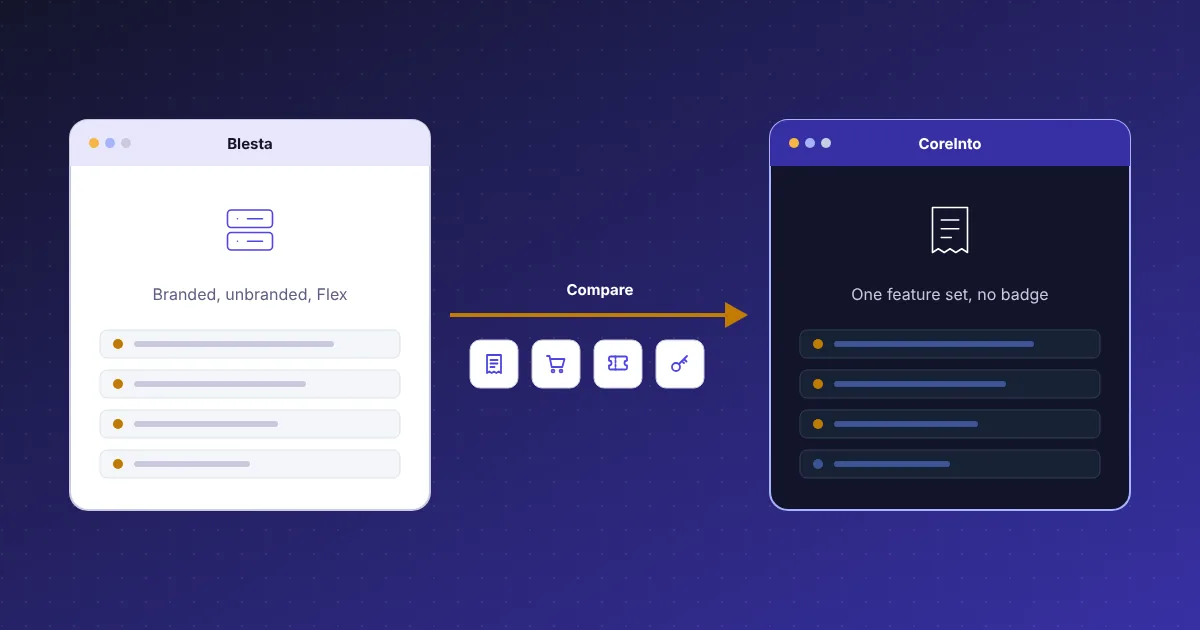
Blesta and CoreInto approach pricing from opposite directions, and understanding that explains most of the rest. Blesta, as published in October 2026, sells a monthly branded licence at $17.95, an unbranded licence at $20.95 and a Flex licence at $23.95, or an owned licence at $350 to $500 with support at $62 a year. The choice is about the kind of licence: whether Blesta's name appears in your client area, whether you rent or own, and how long you want updates and support.
CoreInto has no such choices. Six plans at system.coreinto.com differ only in the number of client accounts an installation may hold: Starter at 250 for $7.99 a month, Plus at 1,000 for $9.99, Pro at 5,000 for $12.99, Business at 25,000 for $15.99 and Unlimited for $19.99, plus a 10-day Free Trial for 25 clients. Yearly prices are $79.99, $99.99, $129.99, $159.99 and $199.99. Every plan has every feature, no plan carries a CoreInto badge, and there is no owned licence to buy.
Which model suits you depends on how you count. A company that prefers to pay once and own its licence has an option at Blesta that CoreInto does not offer. A company that wants the lowest monthly figure, no branding decision and a limit that grows with its client list will find CoreInto's ladder simpler. The pricing page keeps the current CoreInto table.
Branded, unbranded and Flex licences against per-client plans
Blesta's three monthly editions are worth reading closely because they decide what you pay for the same software. Branded at $17.95 a month is the lowest price and carries Blesta's branding; unbranded at $20.95 removes it; Flex at $23.95 is the top monthly tier. The owned licence at $350 to $500 is a one-time purchase, with support and updates continuing at $62 a year. All of these figures are as published in October 2026 and should be checked with the vendor.
CoreInto's monthly range sits below the branded Blesta price at every size up to 25,000 clients, and at $19.99 for unlimited clients it is between Blesta's branded and unbranded figures. More to the point, none of the CoreInto prices depends on branding. There is no badge forced into the client area on any plan, so the question of paying extra to remove it never comes up.
- Blesta branded: $17.95 a month; CoreInto Starter: $7.99 for 250 clients
- Blesta unbranded: $20.95 a month; CoreInto Pro: $12.99 for 5,000 clients
- Blesta Flex: $23.95 a month; CoreInto Unlimited: $19.99 with no client limit
Against the owned licence, the comparison depends on how long you keep the software. Blesta's one-time price plus yearly support is for the vendor to explain in full; CoreInto's yearly plans are simply ten months' price for twelve months. Over a long run, an owned licence may cost less in total; over a short one, a monthly plan carries less risk. Neither answer is wrong, which is why the numbers are here for you to work through.
Blesta's modular plugin architecture and CoreInto's add-on modules
Blesta's reputation rests partly on its architecture. Much of the system is built as plugins and modules, which makes it attractive to companies that intend to extend their billing software in ways the vendor did not plan for. That is a real strength, and if deep customisation is the main reason you are choosing a billing system, it counts in Blesta's favour.
CoreInto is a more fixed application with a smaller module layer. The core covers the whole billing workflow: clients and users, the catalogue, store and checkout, invoices and transactions, five payment gateways, two server modules, five registrar modules, the support desk, affiliates, 23 reports, the Licensing Manager, the WHMCS import, automation, backups and the JSON API. Add-on modules extend it from folders under modules/, each with its own code, pages and README. Gateway Fee and Renewal Pricing are included and the PKNIC .pk module is sold separately; the manual describes how a module is built so a developer can add a gateway, a registrar or a feature of their own.
For integrations that do not need a module, the API at /api/v1 with scoped credentials lets a website, a control panel or a script read and change clients, orders, services, domains, invoices, payments and tickets, and php cli.php runs licence, import and cron commands from a shell. The developer guide documents the module format, the API and the command line.
A store type for software sellers, not only hosts
Billing systems for hosting usually assume you sell hosting. CoreInto makes that an option rather than an assumption. A single setting chooses the store type: a hosting provider, whose public pages show hosting plans and a domain search and transfer box, or a software and licence seller, whose pages drop the domain search and use licence wording throughout. Nothing is lost by switching in either direction, and the store menu title, layout, home heading, text and buttons are configurable alongside it.
Behind the software store type is the Licensing Manager. A product that uses it gives each service a licence key instead of a server account: the key has a prefix, can be bound to an IP address, domain, folder or machine, and is checked by the licensed program at a check address that returns a signed answer, ECDSA P-256 in version 1 and JWT ES256 tokens in version 2. Product codes, editions, account limits, feature lists, trials and grace days describe what the key allows. Clients reissue their own key from the service page when they move. Signed releases let the program download and verify updates with a release key you keep offline.
CoreInto's publisher uses exactly this: panel.stackregent.com, buy.intopanel.com and system.coreinto.com are CoreInto installations selling StackRegent, intoPanel and CoreInto. Whether Blesta offers a comparable built-in licensing manager is for the vendor to say; we do not claim it does or does not. The Licensing Manager page has the full description.
Moving from WHMCS when choosing between Blesta and CoreInto
Many companies reading a Blesta comparison are not on Blesta today; they are on WHMCS and weighing where to go. For that case, CoreInto includes a guided import that reads a WHMCS database from version 7.10 to 8.x and copies currencies, staff, clients and users, products and prices, servers and payment methods, orders, services, domains, invoices and payments, credit, quotes, tickets, the knowledgebase, downloads, announcements, affiliates, the to-do list and, if you want them, email history and settings.
The sequence is check the database, import now, and run again until you switch. After each run a comparison report puts WHMCS counts beside CoreInto counts, and notes list what was skipped on purpose, so you can correct a mapping and repeat. A wipe option clears the previous import first. Services keep their next due dates and domains their expiry dates, so renewal invoices continue without a gap. Shell users can run php cli.php import-whmcs for large databases.
Blesta's own import tools are for the vendor to describe and we state nothing about them here. What we can say is that the CoreInto import is not a separate product or a paid service; it is part of every plan, including the trial, where it runs up to the 25-client limit so you can check the comparison report before buying. The WHMCS import page walks through each screen and the WHMCS alternative page lays out the switch in five steps.
Everyday billing work: invoices, reminders and suspensions
Whichever system you choose, most days are spent on the same tasks, so here is how CoreInto handles them. Invoices are generated ahead of due dates by the daily automation run, with statuses, a numbering scheme, PDFs with your logo and batch PDF export. Reminders go out on a schedule you set, late fees are added, and unpaid services are suspended and then terminated automatically through the server module, with the reason recorded. Invoices can be split, merged or cancelled, and refunds can be sent back through the gateway.
Money is tracked as transactions with reversals, a credit balance per client in their own currency, add funds, mass pay, billable items, quotes, credit and debit notes and disputes. Tax rules set rates by country and state, inclusive or exclusive, with a tax ID label. Currencies carry exchange rates, and a client's currency can be chosen by country through GeoIP. Renewal dates and proration are handled when a service is upgraded or downgraded mid-term.
All of this runs from one cron job that performs the daily tasks, including invoice generation, reminders, suspension, termination, domain sync and notices, currency rates, backups and pruning, and the frequent tasks, including the email queue, ticket mailboxes and the module queue. Utilities > Automation Status shows what ran and when. How Blesta performs these tasks is documented by its vendor; the billing automation page covers the CoreInto side in detail.
Where Blesta's strengths may still win
A fair page says where the other product is likely to be the better fit, and Blesta has several such cases. The first is the owned licence. If you would rather pay $350 to $500 once, as published in October 2026, and renew support at $62 a year than pay monthly for as long as you use the software, Blesta offers that and CoreInto does not. For a company planning to run the same billing system for many years, that can matter more than the monthly figure.
The second is the modular plugin architecture. Blesta is designed so that much of its behaviour can be replaced or extended through plugins, and companies that have built, or intend to build, their own deep integrations will find more room to do so. CoreInto's add-on modules, API and command line cover a good deal, but the core application is less open to replacement piece by piece.
The third is maturity. Blesta has been sold for years and has a community, documentation and third-party modules that CoreInto does not claim to match. CoreInto's built-in gateways and registrar modules were written against the providers' documentation and should be tried in sandboxes before real money or real domain orders go through them. If you weigh those three points above price, branding and the Licensing Manager, Blesta may be the right answer, and we would rather you reach it here than after a migration.
Choosing between Blesta and CoreInto with a free trial
Reading comparisons gets you only so far; running the software with your own records gets you the rest of the way. CoreInto's Free Trial lasts 10 days, holds 25 client accounts, needs no card and is limited to one per installation. Upload the files to a hosting account with PHP 8.1 to 8.5, create an empty MySQL or MariaDB database, open /install/, enter the trial key when asked and add the cron job. The full feature set is there from the first sign-in.
Spend the ten days on what you would actually do. Create a few products with monthly and yearly prices, configurable options and a promotion, and place an order through the store as a guest. Pay it with Stripe or PayPal in sandbox mode and watch the invoice, transaction and service appear. Suspend the service by hand and through automation. Add a software product that uses the Licensing Manager and check a key from a script. If you are on WHMCS, import a copy of the database and read the comparison report.
Check the client side as well: switch between Classic and Horizon, light and dark, and between English and Urdu, and open a ticket by email through a department mailbox. When the trial ends, buy the plan that matches your client count and enter the key under Utilities > CoreInto Licence; your data and settings stay as they are. Questions go to a ticket or sales@coreinto.com, and the free trial page has the install steps.