Why hosting companies choose self-hosted billing software
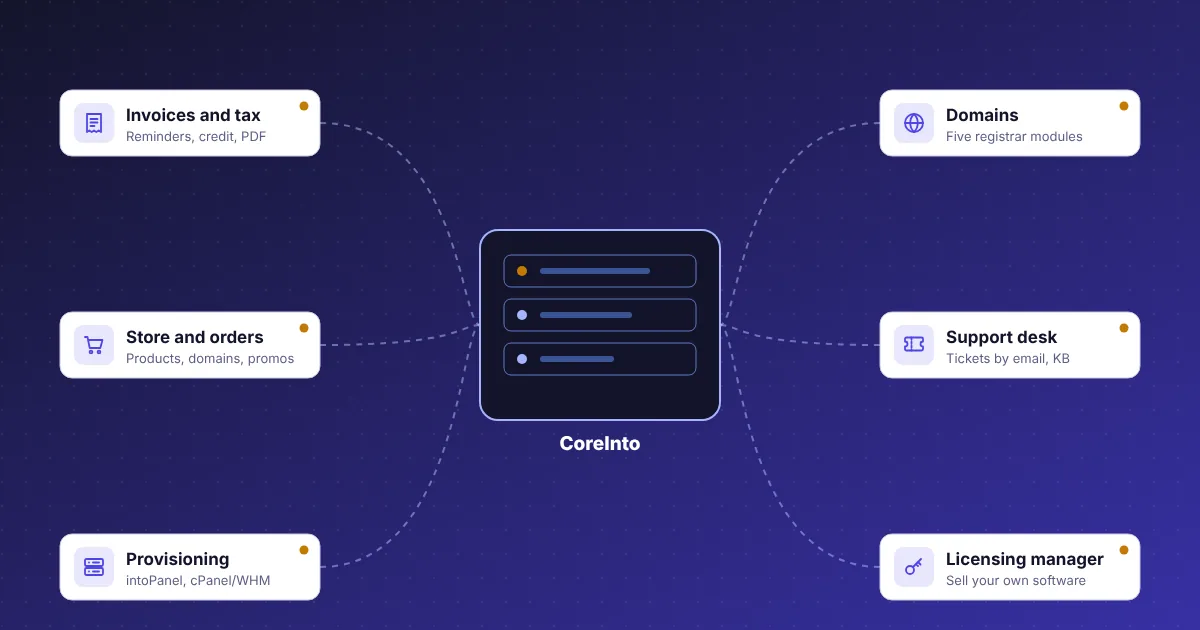
A hosting company's billing system holds the records that keep the business running: who owes what, which accounts are live on which server, when each domain renews and what every client has asked for in support. CoreInto keeps all of that on a hosting account you control. The files are PHP, the database is MySQL or MariaDB, and the only outside connection the application needs is a daily licence check against system.coreinto.com.
Self-hosting also sets the cost. Because CoreInto does not run your database for you, a plan is priced by the number of client accounts rather than by features. The Starter plan holds 250 clients for $7.99 a month, and the Unlimited plan removes the limit for $19.99 a month. Each plan has the same catalogue, gateways, modules, support desk and API.
Control extends to the details. The admin folder can be renamed so it is not found at a predictable address. Staff accounts can be required to use two-step sign-in. Every secret the application stores, from Stripe keys to saved card tokens, is encrypted with a key that lives in the configuration file rather than in the database, so a copy of the database alone does not expose them.
Invoicing and payments built for recurring hosting
Hosting is sold by the month, the year or longer, and the invoices have to arrive before the due date without anyone remembering to send them. CoreInto generates renewal invoices ahead of each due date, sends reminders, adds late fees when you have set them, and suspends and then terminates services that stay unpaid, all from the daily automation run.
Invoices carry your logo, follow the numbering scheme you choose and can be split, merged or cancelled. Staff can export a batch of invoices as PDF for the accountant. Tax rules apply rates by country and state, inclusive or exclusive of the price, with a configurable tax ID label on the invoice. Proration handles mid-term changes so a client who upgrades today pays for the remainder of the term rather than a fresh full term.
Payment arrives through the built-in gateways: PayPal, Stripe with cards, Apple Pay, Google Pay and saved cards, JazzCash and Easypaisa for Pakistan, or manual methods such as bank transfer, mobile wallet and cash. Every gateway answer is written to the gateway log, refunds can be sent back through the gateway, and clients can add funds to a credit balance in their own currency to pay future invoices automatically. Read more on the payment gateways page.
Automatic hosting account provisioning on cPanel and intoPanel
When an order is accepted or paid, CoreInto can create the hosting account itself. The cPanel & WHM module talks to WHM API 1 with a token on port 2087; the intoPanel module uses the panel's /api/v1 with a Bearer token on port 7443. Both modules can test the connection, read the packages on the server, create an account, suspend it with a reason, unsuspend it, terminate it, change its package, change its password, read disk and bandwidth use and sign staff straight into the panel.
You decide when set-up happens: on order, on payment or on acceptance by staff. Servers are listed and grouped under Settings, and a product is pointed at a server group so new accounts land where there is room. Actions that cannot complete at once wait in the Pending Module Actions queue, and the module log records each call with secrets hidden.
A service then follows its life in CoreInto: creation, fixed terms, upgrades and downgrades along the paths you allow, cancellation requests from the client, suspension for non-payment and termination. Clients see their services in the client area with the next due date, a status badge and a Manage button. The hosting automation page walks through each step.
Domain registration and renewal from the same client area
Domain sales share the cart, checkout and invoice with hosting, so a client can order a plan and register a domain in one go, and a free domain with hosting can be offered as a promotion. Pricing is set per TLD for registration, transfer and renewal by number of years, with flags for EPP codes and ID protection.
Registrar modules for ResellerClub, Namecheap, Spaceship, Porkbun and Dynadot do the work at the registrar: registration, transfer, renewal, nameserver changes, transfer lock, contacts and EPP code retrieval. They were built against the public APIs, and the manual recommends a test account before real orders. A PKNIC module for .pk domains is sold separately and works the SRS member dashboard. For registrars without an API, CoreInto raises a staff task instead so nothing is forgotten.
Existing domains can be brought in and matched to clients. A sync task keeps dates and statuses current, renewal notices go out before expiry, and the client's My Domains page shows active domains, domains expiring within 30 days and pending ones. WHOIS and availability checks run from the store's domain search. See the domain reseller billing page for the full list.
A support desk that lives next to the billing records
Support staff answer faster when the ticket sits beside the client's services, invoices and domains. CoreInto's support area takes tickets from signed-in clients, from visitors who are not signed in, from staff and from email, and shows them in one queue with the client's account one click away.
Departments each have a mailbox, so tickets can arrive by email piping or by polling a POP or IMAP mailbox. Ticket statuses, escalation rules and spam control are settings. Predefined replies save typing, Markdown is allowed in messages, and guest tickets get an access link so a visitor can follow the thread without an account. Idle tickets are closed and old attachments removed by the automation run, so the queue stays clean without anyone tidying it by hand.
Around the tickets sit a knowledgebase, announcements, a downloads section and a network issues page, each visible in the client area. Clients see tiles for open tickets, tickets awaiting their reply and closed ones, with a notice when a reply is waiting. The support desk page lists every setting.
Selling software licences alongside hosting plans
Not everything a hosting company sells needs an account on a server. The Licensing Manager lets a product issue a licence key instead, so plugins, panels, scripts or any other software can be sold by subscription through the same store, invoices and gateways as hosting. CoreInto's own publisher uses it to sell intoPanel and StackRegent.
Each service gets a key with a prefix you choose. The key can be bound to an IP address, a domain, a folder or a machine, and a client can reissue it from their service page to move the software, after which it binds again at its next check-in. Answers from the check address are signed with ECDSA P-256, and version 2 adds JWT ES256 tokens, product codes, editions, account limits, feature flags, trials and grace days.
Signed releases close the loop: a licensed program downloads updates from your installation and verifies them with a release key you keep offline, so a tampered file is rejected. Every check is written to a licence checks log. Switching the store type to software and licence seller removes the domain pages and changes the wording to suit. Details are on the Licensing Manager page.
Moving from WHMCS with the guided import
Leaving a billing system usually means leaving its data, which is why so many companies stay. CoreInto reads a WHMCS database directly, versions 7.10 to 8.x, and copies currencies, staff, clients and their users, products and prices, servers and payment methods, orders, services, domains, invoices and payments, credit, quotes, tickets, the knowledgebase, downloads, announcements, affiliates, the to-do list, email history and settings.
The import is guided: check the database, import now, then run it again as often as you like until the day you switch over, so the two systems stay in step while you test. A comparison report shows the counts on each side, and notes list what was skipped on purpose and why. Large imports can run from the command line with php cli.php import-whmcs when the hosting account has shell access.
After the switch, the same cron job takes over renewals, reminders and suspensions, and registrar modules continue to manage the domains already at ResellerClub, Namecheap, Spaceship, Porkbun or Dynadot. The WHMCS import page explains the steps, and the comparison with WHMCS covers the price difference.
How much does CoreInto cost per month
Plans are sold at system.coreinto.com and differ only by the number of client accounts an installation may hold. Starter holds 250 clients for $7.99 a month or $79.99 a year. Plus holds 1,000 for $9.99 or $99.99. Pro holds 5,000 for $12.99 or $129.99. Business holds 25,000 for $15.99 or $159.99, and Unlimited removes the cap for $19.99 or $199.99. Yearly billing works out to about two months free.
There are no branded and unbranded tiers, because no CoreInto badge is forced into your client area on any plan. There is also no feature ladder: the Starter plan runs the same gateways, registrar modules, server modules, Licensing Manager, API and WHMCS import as Unlimited, so a small reseller and a large host install the same software.
A free trial runs for ten days with room for 25 clients, needs no card and is limited to one per installation. When it ends, you buy a plan and enter the new key under Utilities, CoreInto Licence, without reinstalling. Full figures and a comparison with WHMCS, Blesta and Clientexec are on the pricing page.